
Steak at home can turn out restaurant-level. Seriously. You don’t need a grill, a “space-grade” pan, or some special talent.
You need three things: great beef, high heat, and… five minutes of patience (for resting).
You need three things: great beef, high heat, and… five minutes of patience (for resting).
In this guide you’ll get:
- a temperature chart (rare / medium rare / medium),
- a simple step-by-step pan method,
- 10 mistakes that make steak dry or grey,
- plus a bonus: a 3-minute pan sauce.
1) Which cut is best for pan-searing?
If you want the classics:
- ribeye – the most “buttery”; fat does the heavy lifting,
- striploin / sirloin – beefy, even, and beginner-friendly,
- tenderloin – delicate and lean (easier to overcook).
If you want to try “butcher’s cuts” (often the best value for the result):
bavette, flank steak, picanha, spider steak, “gruszka”, “krzyżowa”, “sielawka”, “orzech”.
These cuts love high heat and short cooking, and the key to tenderness is slicing against the grain (especially with bavette and flank).
Classic steaks
Butcher’s cuts
Steakownia tip: if you’re cooking bavette or flank, let it rest and then slice it thinly against the grain. That changes the eating experience more than “30 extra seconds in the pan”.
2) The most important part: the steak temperature chart
This is the “save it for later” cheat sheet. The best way is using a meat thermometer (most reliable), but I’m also telling you when to pull the steak off the pan.
Note: steak continues cooking after you take it off the heat (carryover cooking).
That’s why you should pull it 2–3°C / 3–5°F before your target temp.
Doneness – target internal temperature
- Rare: 50–52°C
- Medium rare: 54–56°C
- Medium: 58–60°C
- Medium well: 62–65°C
- Well done: 66°C+
When to pull it from the pan (internal temp):
- rare: 48–50°C
- medium rare: 52–54°C
- medium: 56–58°C
3) Pan-seared steak step by step (a method that always works)
Step 1: Take the steak out of the fridge
15–30 minutes is enough so it’s not ice-cold.
You don’t need “room temperature” steak—just don’t make the pan fight a block of cold meat.
Step 2: Pat it dry
Paper towel. Dry surface = better crust.
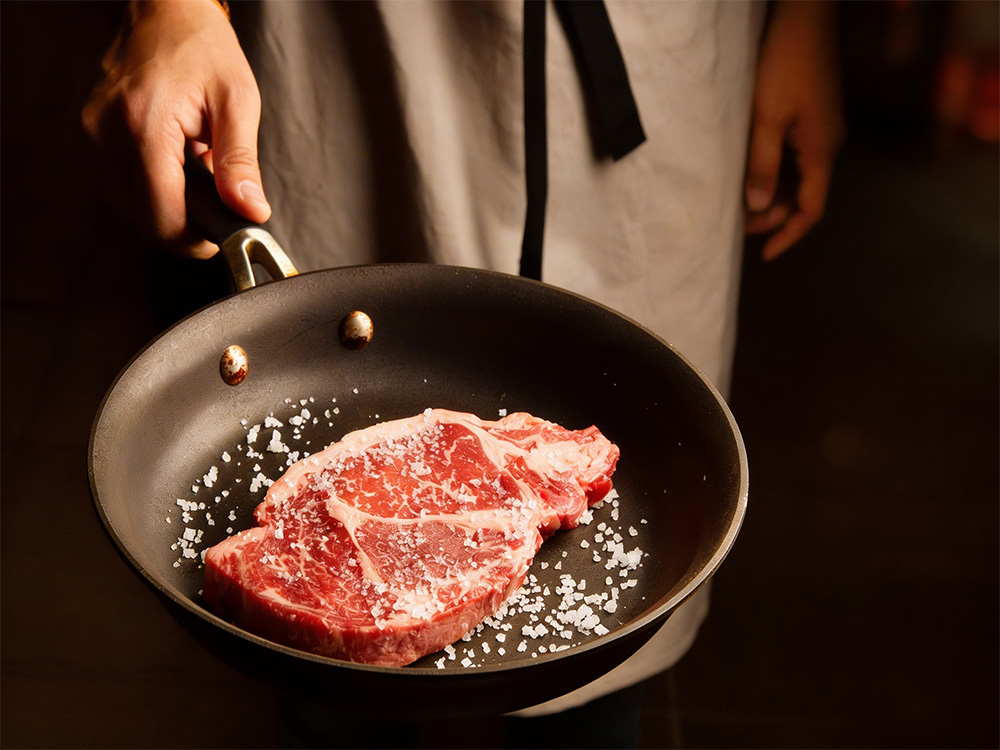
Step 3: Salt & pepper
The simplest approach:
- salt right before searing (or 40+ minutes earlier if you do a dry brine),
- add pepper after searing if you worry about it burning.
Step 4: Preheat the pan properly
The pan should be really hot. Use a fat suitable for high heat (don’t start with butter).
Pro tip: beef tallow.
If you want to level up, sear your steak in beef tallow—it has a higher smoke point than butter, handles high heat well, and adds a clean “beefy” flavour without extra work.
Beef tallow for steak searing (https://www.steakowniastore.pl/pl_PL/products/loj-wolowy)
Step 5: Searing
- place the steak and don’t move it for 60–90 seconds (crust time),
- flip and repeat,
- then you can flip more often (every 30–60 seconds) for more even doneness.
Cooking time depends on thickness—a thermometer beats a timer.
Step 6: Butter + aromatics (at the end)
For the last 1–2 minutes:
- butter,
- garlic,
- thyme/rosemary,
- spoon the foaming butter over the steak (basting).
Step 7: Rest
5–8 minutes (depending on thickness).
It’s not optional—it’s part of cooking.
4) Reverse sear (for thicker steaks)
If your steak is 4–6 cm thick and you want sniper-level control:
- oven at 90–120°C until internal temp reaches ~45–48°C,
- then a quick finish in a ripping-hot pan: 45–60 seconds per side.
That gives you an even interior + an amazing crust.
5) 10 mistakes that ruin steak (and how to avoid them)
- Wet surface → no crust. Pat dry.
- Pan not hot enough → the steak steams and turns grey. Heat it up properly.
- Too many steaks at once → the pan cools down. Cook in batches.
- Poking with a fork → juices leak out. Use tongs.
- No resting → juices on the board, dry steak. Rest 5–8 minutes.
- Butter too early → it burns. Add butter at the end.
- Using a fat that burns quickly → bitter flavour and smoke. Choose a high-heat fat (e.g., beef tallow).
Beef tallow - Slicing with the grain (especially butcher’s cuts) → chewy. Slice against the grain.
- Cooking “by time” only → it’s a gamble. Thermometer = peace.
- Not seasoning after resting → a final pinch of salt/pepper often makes it pop.
6) A 3-minute pan sauce (no fuss)
After you remove the steak:
- add a splash of broth to the pan,
- scrape up the browned bits (that’s flavour),
- reduce for 2–3 minutes,
- finish with a tablespoon of butter and swirl.
It’s the simplest pan sauce in the world—and it tastes restaurant-level.
Drinking broths / cooking broths
7) FAQ
What internal temperature is medium rare?
Target 54–56°C (pull at 52–54°C).
How long should I sear a steak in a pan?
It depends on thickness and pan heat—use a thermometer. At 2.5–3 cm, it’s usually just a few minutes total, but temperature beats timing.
Should I salt before or after cooking?
Easiest: salt right before searing. Alternatively, salt 40+ minutes earlier (dry brine) for an even better texture.
Does steak really need to rest?
Yes—5–8 minutes makes a big difference in juiciness.
Summary
A perfect pan-seared steak isn’t magic. It’s high heat, a great crust, a thermometer, and proper resting.
And if you want an easy upgrade: beef tallow for searing + a quick broth-based pan sauce = “restaurant at home” without extra effort.
Steaks – choose your cut for the pan
Butcher’s cuts – big flavour, great value
Beef tallow – the best fat for searing
Broths – a 3-minute pan sauce